

How we researched this: We didn't wear-test or impact-test these frames, and we have no lab. We read the ANSI/ISEA Z87.1 text, OSHA's rule, and each seller's spec page (checked October 8, 2026).
Decision table: which Rx safety setup fits your job
| Your situation | Best setup | What to check on the label |
|---|---|---|
| All-day wear in a shop, warehouse or site with flying-particle risk | Rx safety glasses with side shields | Frame "Z87-2+", Rx lenses: lens maker's mark + "+" |
| You change jobs and tasks often and want one pair | Dedicated Rx safety glasses | Side shields permanent or certified removable |
| Occasional, short exposure | Over-the-glasses (OTG) protector | Z87+ on the OTG; fits without moving your glasses |
| Chemical splash or dust | Goggles (often worn over glasses or with an Rx insert) | D3 (splash), D4 (dust), D5 (fine dust) |
| You want prescription sunglasses for outdoor work | Rx safety frame with tinted Rx lenses | Frame Z87-2+; lenses with maker's mark, "+", and a UV marking ("U" scale) if claimed |
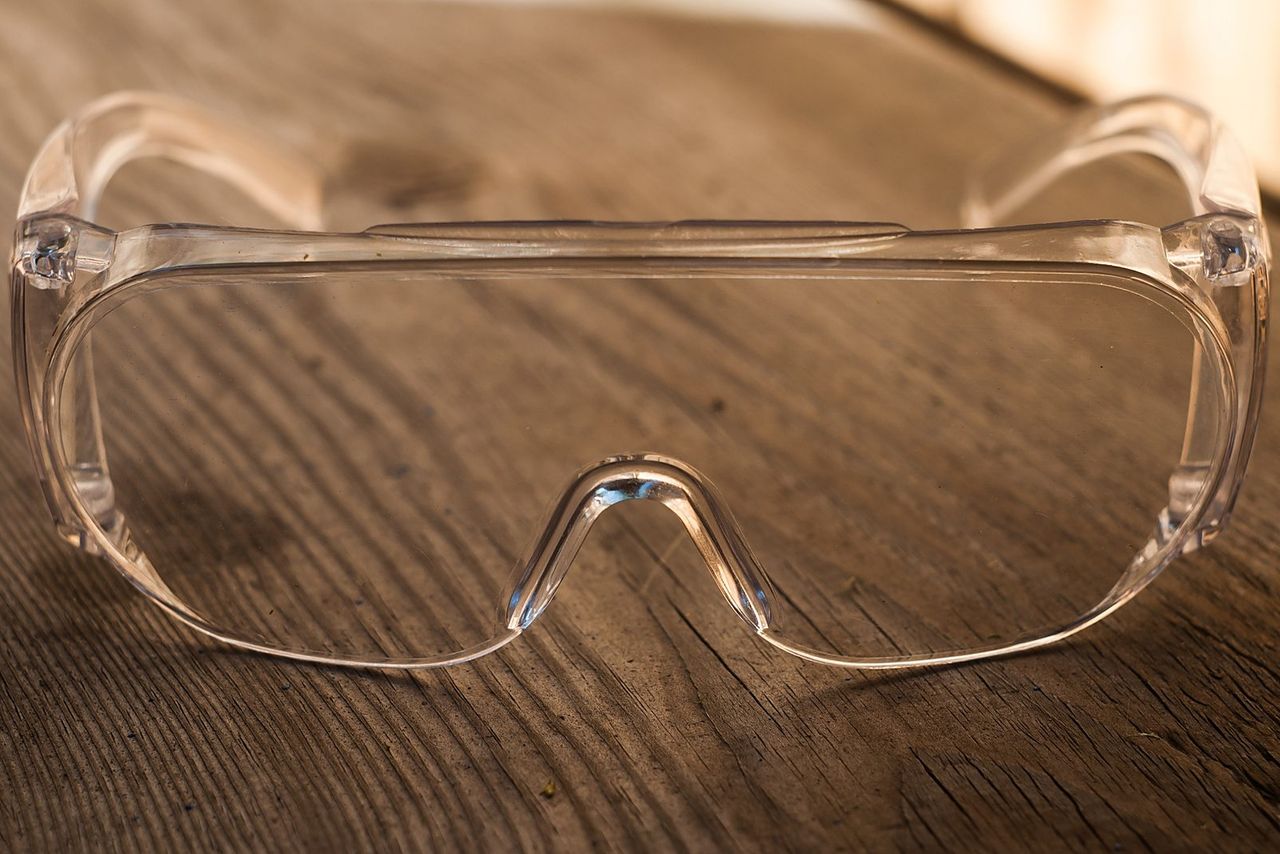
What "Z87-2+" means
Under the ANSI/ISEA Z87.1 marking table (2020 text):
- Z87 on a frame means it meets the standard. "+" means the device is impact-rated: it passed the standard's high-mass and high-velocity tests.
- A frame made to hold prescription safety lenses is marked Z87-2, and Z87-2+ if it meets the high-impact requirements. Prescription lenses are marked with the lens maker's logo, plus a "+" if impact-rated. Non-prescription (plano) lenses are marked Z87 or Z87+.
- Impact-rated protectors must give continuous side coverage, with no openings larger than 1.5 mm in the defined area.
The impact tests behind the "+" (2020 text): a pointed projectile of at least 500 g dropped from 127 cm (50 in.), and a 6.35 mm steel ball at 45.7 m/s (150 ft/s) for spectacles. Frames meant for prescription lenses are tested with representative lenses at the thinnest thickness the maker will use, and never less than 2.0 mm.
The standard also sets minimum Rx lens thickness: 3.0 mm for regular prescription safety spectacles (2.5 mm for strong plus powers over +3.00 D) and 2.0 mm for impact-rated ones.
Practical takeaway: "safety frame" plus "ordinary lenses" doesn't equal safety glasses. Check that the frame carries Z87-2+ and the finished lenses carry the lens maker's logo with a "+".
What OSHA requires (and doesn't)
OSHA's eye and face protection rule, 29 CFR 1910.133, says:
- Employers must ensure workers use appropriate eye or face protection when exposed to hazards such as flying particles, molten metal, liquid chemicals, acids or caustic liquids, chemical gases or vapors, or potentially injurious light radiation (1910.133(a)(1)).
- Protection must include side protection when there's a flying-object hazard. Clip-on or slide-on side shields that meet the requirements are acceptable (a)(2).
- Workers who wear prescription lenses must use eye protection that incorporates the prescription, or protection that can be worn over the prescription lenses without disturbing either (a)(3).
- Devices must comply with the Z87.1 editions listed in the rule (2010, 2003 or 1989), or be shown by the employer to be at least as effective (b).
OSHA does not say you must buy Rx safety glasses rather than OTGs. Both routes are allowed. In a 2013 interpretation letter about re-lensing old safety frames, OSHA pointed back to the consensus standards rather than giving a blanket yes or no. Ask your safety manager before you put new lenses in an old frame.
RatedEyewear can't certify compliance. Follow OSHA and your employer's requirements and hazard assessment.
Our picks (spec-based, not hands-on)
1. RX-15011 (sold by RX Safety): best budget Z87-2+ frame
- Standard claim (per RX Safety): "meet the rigorous industrial standards ANSI Z87-2+, EN 166 and CSA Z94.3." Its spec list shows "ANSI Z87+, CSA Z94.3, EN 166." Brand listed: Phillips Safety.
- Build (per seller): TR-90 nylon frame with integrated side shields, rubberized adjustable nose pads and temple bars.
- Size (per seller): lens 57 mm wide × 40 mm tall, bridge 15 mm, temples 125 mm, frame width 140 mm.
- Lens options: single vision, lined bifocal, progressive or non-prescription. Polycarbonate 1.59 is listed as "ANSI Z87+ High Impact Rated."
- Listed price: $45.00 starting (checked October 2026). Lens upgrades cost extra.
- Note: EN 166 has been replaced by EN ISO 16321-1 for new EU certifications. That doesn't affect US use. See our standards comparison.
- See RX-15011 at RX Safety
2. HiDX H207 (sold by Eyelation): best for removable side shields
- Standard claim (per Eyelation): "a prescription safety eyewear frame that meets ANSI Z87-2+ standards."
- Build (per seller): polycarbonate frame with "removable or permanent side shields," and "compatible with higher prescriptions."
- Sizes (per seller): Medium (54 mm lens, 16 mm bridge, 150 mm temples) and Large (57 mm lens, 16 mm bridge, 150 mm temples).
- Lens options: single vision, bifocal or progressive. Optional anti-fog, anti-reflective and blue-light coatings (the seller's claims).
- Listed price: $53.00 sale price (checked October 2026). Lenses priced separately.
- See HiDX H207 at Eyelation
3. Wiley X WX Founder: best "doesn't look like safety glasses" option
- Standard claim (per Wiley X): "ANSI Z87.1+ Optical clarity and high mass/high velocity impact standards." Its "Permanent and Removable Side Shields easily snap into place to meet ANSI Z87.1+ Safety Standards."
- Prescription (per Wiley X): "The only way to ensure your glasses are ANSI-rated… is to have your prescription filled by Wiley X or a certified partner lab." Wiley X says it can make Rx lenses from -7.00 to +5.00 in most styles.
- Frame (per Wiley X): flatter 6-base lens profile, Triloid nylon frame, Selenite polycarbonate lenses. Lens 56 mm, bridge 17 mm, temples 134 mm. Medium or large fit.
- Listed price: $150 regular for the non-Rx version (checked October 2026). Rx pricing goes through Wiley X dealers.
- Before you buy: confirm the frame is marked Z87-2+ for Rx use and that the finished lenses will carry the lab's mark with a "+". The product page says Z87.1+ but doesn't state the Z87-2 frame marking.
- See WX Founder at Wiley X
How to order Rx safety glasses without mistakes
- Get a current prescription with your pupillary distance (PD). Online sellers need it.
- Pick the frame by the job. Side shields if there's a flying-particle hazard. Goggles if there's splash or dust.
- Choose an impact lens material. Sellers usually default to polycarbonate. ASTM's sports standards also warn that polycarbonate is the most impact-resistant spectacle lens material, a useful cross-check.
- Ask about markings. You want Z87-2+ on the frame and the lens maker's mark with "+" on each lens.
- Ask your employer first. Many have an approved-vendor program or pay for Rx safety glasses.
Bottom line
Buy a frame marked Z87-2+ and make sure the finished lenses carry the lens maker's mark with a "+". Then confirm the setup fits your employer's hazard assessment. As of October 2026, the RX-15011 and HiDX H207 state Z87-2+ outright. The Wiley X WX Founder is a Z87.1+ frame whose Rx lenses must come from Wiley X or a certified lab.
Reference tables
| Marking | Where | Meaning |
|---|---|---|
| Z87 | Frame, plano lens | Meets the standard |
| Z87+ | Frame, plano lens, side shields | Impact-rated |
| Z87-2 | Prescription safety frame | Rx frame meeting the standard |
| Z87-2+ | Prescription safety frame | Impact-rated Rx frame |
| Maker's mark + "+" | Prescription lens | Impact-rated Rx lens |
| D3 / D4 / D5 | Goggles | Splash/droplet / dust / fine dust |
| X | Lens | Anti-fog (lens stayed fog-free ≥8 s in test) |
| Model | Standard stated | Side shields | Sizes | Listed price |
|---|---|---|---|---|
| RX-15011 | ANSI Z87-2+, CSA Z94.3, EN 166 | Integrated | 57-15-125 | From $45 + lenses |
| HiDX H207 | ANSI Z87-2+ | Removable or permanent | 54/57-16-150 | $53 sale + lenses |
| Wiley X WX Founder | ANSI Z87.1+ | Permanent and removable | 56-17-134 | $150 (non-Rx) |