
How we researched this: We read ASTM International's product page for ASTM F659-10(2018), ISO's catalogue page and the publicly posted sample pages of ISO 18527-1:2021, the European Union's official lists of harmonised standards for protective equipment, and the EU regulation on personal protective equipment. We checked them on October 29, 2026. We don't test eyewear. A standard printed on a package is the manufacturer's own claim.
The short version
- ASTM F659, the US ski and snowboard goggle standard, has been withdrawn. ASTM's store lists it as "Withdrawn 2024," and the page doesn't name a replacement.
- EN 174, the old European ski goggle standard, has been replaced by EN ISO 18527-1:2022, which is the European adoption of the international standard ISO 18527-1:2021. The EU stopped listing EN 174 as a harmonised standard on November 11, 2024.
- S0 to S4 are lens tint categories from ISO 18527-1. S0 is the lightest, S4 the darkest. The UV limits a lens has to meet are set per category.
- Fog resistance is an optional test in ISO 18527-1. A goggle can meet the standard without a fog claim, so look for one if fog matters to you.
- No goggle standard is a helmet. These standards are about the eyes, the area around them, and how well you can see.
ASTM F659: what it covered, and its withdrawal
ASTM F659 came from ASTM's sports equipment committee, F08. The last edition was F659-10, reapproved in 2018. ASTM's product page now marks the standard "Withdrawn 2024." A withdrawn ASTM standard is no longer maintained by ASTM. ASTM's page doesn't give a reason, and we couldn't find one published.
While it was active, its scope said three things a skier should know:
- It was for non-motorized skiing and snowboarding. Its stated goal was "a reasonable degree of protection" against snow and moisture striking or lodging in the eye or the soft tissue around it.
- It set requirements for materials, optics, lens strength and retention, and labeling, along with the test methods.
- Contact lenses, sunglasses and everyday prescription glasses were outside its scope. It warned that anyone wearing glasses under a goggle should wear impact-resistant spectacles that meet ANSI Z87.1.
ASTM's summary of the standard goes further. It lists optical checks (field of view, light transmission, refractive power and prism errors, lens defects), UV and infrared filtering, fog resistance, and two levels of impact test, "basic" and "higher" impact resistance. It also says the aim included minimizing "fogging and vision restrictions" that could distract a skier and lead to accidents. The test values are in the paid standard, so we don't summarize them here.
What this means for you: you may still see "ASTM F659" on older goggles or listings. It tells you which specification the maker says it followed. It doesn't mean the goggle meets a standard ASTM still maintains.
"Withdrawn" isn't the same as "unsafe." A goggle made to F659 hasn't become worse overnight. It just means there's no active US standard behind that claim, so the label alone tells you less than it used to.
From EN 174 to EN ISO 18527-1
For years, goggles sold in Europe were usually made to EN 174:2001, "Personal eye-protection – Ski goggles for downhill skiing." That has changed.
- In 2023, the European Commission published EN ISO 18527-1:2022 in its list of harmonised standards for protective equipment (Implementing Decision (EU) 2023/941). The same decision set November 11, 2024 as the date EN 174:2001 was withdrawn from that list.
- The Commission's current list, Implementing Decision (EU) 2026/1279 of June 12, 2026, still includes EN ISO 18527-1:2022.
- In the UK, BSI's edition, BS EN ISO 18527-1:2022, says in its foreword that it is identical to ISO 18527-1:2021 and supersedes BS EN 174:2001.
In plain terms: EN ISO 18527-1:2022 and ISO 18527-1:2021 are the same technical text. The "EN" just means Europe adopted it. A goggle label may show either form.
If you see EN 174 on a goggle, it was most likely designed before the switch. As with F659, it tells you what the maker followed, not what the current standard requires.
| Standard on the label | Status (checked October 2026) | Source |
|---|---|---|
| ASTM F659 | Withdrawn by ASTM in 2024, no replacement named | ASTM store page |
| EN 174:2001 | Withdrawn from the EU harmonised list on Nov. 11, 2024 | EU Decision 2023/941 |
| EN ISO 18527-1:2022 | Current EU harmonised standard | EU Decision 2026/1279 |
| ISO 18527-1:2021 | Current international edition (first edition) | ISO catalogue page |
What ISO 18527-1 covers
ISO 18527-1 is titled "Eye and face protection for sports use — Part 1: Requirements for downhill skiing and snowboarding goggles." It was written by ISO's eye and face protection subcommittee (ISO/TC 94/SC 6) together with the European standards body's eye protection committee, CEN/TC 85. The first edition was published in March 2021. ISO's catalogue page lists it as published and at stage 90.60, "close of review," part of ISO's routine check of whether a standard needs updating.
Its scope covers goggles with plano (non-prescription) lenses that protect against:
- ultraviolet and visible sunlight,
- rain,
- snow, and
- wind,
during downhill skiing, snowboarding and similar activities. It also applies to goggles fitted with an insert that carries prescription lenses.
It doesn't apply to:
- eye protection for driving or riding a motorized vehicle, such as a snowmobile,
- protection from artificial light sources, such as tanning beds,
- looking directly at the sun, and
- sports with unrelated hazards.
The contents list in the public sample shows what the standard tests: lens tint and UV transmission, scattered light (haze), refractive power and prism (whether the lens distorts what you see), mechanical strength across a temperature range, resistance to solar UV, resistance to ignition, protection against water and snow, field of view, the minimum area the goggle must cover, and marking and information from the manufacturer. It also requires the headband to hold the goggle securely on the back of the head or on a helmet.
Lens categories S0 to S4
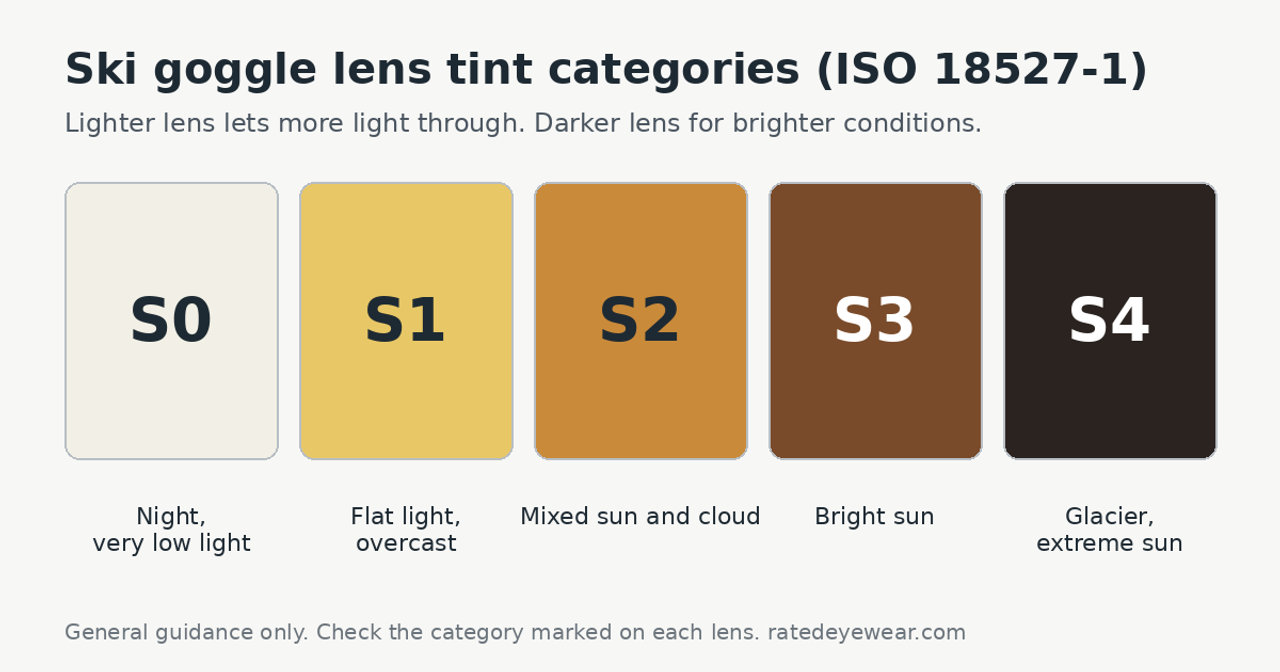
Under ISO 18527-1, every ski or snowboard lens has to be placed in one of five tint categories based on how much visible light passes through it. The standard labels them S0 to S4. Each category also has its own maximum UV-A and UV-B transmission, so a lens has to block UV in proportion to how dark it is.
| Category | Tint | Typical use (general guidance) |
|---|---|---|
| S0 | Lightest, close to clear | Night skiing, very low light |
| S1 | Light | Overcast days, flat light, snowfall |
| S2 | Medium | Mixed or changing conditions |
| S3 | Dark | Bright sun |
| S4 | Darkest | Very bright conditions, such as high-altitude glaciers |
The "typical use" column is our plain-English summary of what each tint level means, not wording from the standard. The standard's own selection advice is in an informative annex (Annex A) that isn't in the public sample. Follow the manufacturer's leaflet for the conditions a lens is meant for.
A few special cases from the standard:
- Photochromic lenses (lenses that darken in sunlight) are described with two categories, one for the lightest state and one for the darkest. They're measured in the cold, at about 5 °C (41 °F), and must meet the UV and tint requirements in both states.
- Polarized lenses have to meet extra requirements for alignment and polarizing efficiency if the maker claims they're polarized.
- Gradient lenses (darker at the top) are categorized by the tint at the lens's reference point.
- Blue-light or extra UV claims are optional. If a maker claims a specific percentage, the standard sets how that claim is checked.
Fog, cold and impact: mandatory vs. optional
This is where label reading pays off, because ISO 18527-1 splits its tests into mandatory and optional ones. Some optional tests become mandatory when the maker claims that feature.
| Test in ISO 18527-1 | Mandatory or optional |
|---|---|
| Tint category and UV transmission | Mandatory |
| Optical quality (haze, power, prism) | Mandatory |
| Mechanical strength "level 2" across a temperature range | Mandatory |
| Resistance to solar UV aging and to ignition | Mandatory |
| Protection against water and snow; field of view; coverage area | Mandatory |
| Extended low-temperature range | Optional |
| Resistance to fogging | Optional |
| Resistance to abrasion (scratching) | Optional |
So a goggle can meet ISO 18527-1 without any fog or scratch claim. That surprises many skiers. If you ski in wet snow or sweat a lot on the way up, check whether the maker states an anti-fog claim under the standard, not just the word "anti-fog" on the box.
For context, the EU's protective equipment regulation says eye protection must be "treated or provided with means to prevent misting-up" if necessary. The old ASTM F659 listed fog resistance among its requirements, according to ASTM's summary.
Impact: we can't tell you the impact test details. ISO 18527-1 calls its test "mechanical strength level 2," and F659 had "basic" and "higher" impact tests, but the energies and projectiles are in the paid texts. What we can say is that these are lens and frame strength tests, not a promise that a goggle will survive a crash, a tree branch or a ski edge.
How to read the markings
Most of what you need is printed on the frame, the strap end, the box or the user leaflet. Before you buy:
- Look for the standard number and year. "EN ISO 18527-1:2022" or "ISO 18527-1:2021" points to the current standard. "EN 174" or "ASTM F659" points to an older or withdrawn one.
- Find the lens category. Look for S0 to S4, or two categories for a photochromic lens. Interchangeable lenses should each have their own category.
- Check for the CE marking in Europe. Under the EU regulation, protective equipment sold in the EU has to carry the CE marking. A standard number with no CE marking on a product sold in Europe is a reason to ask questions.
- Read the leaflet. ISO 18527-1 requires information from the manufacturer, such as how to clean the goggle. That's where claims like fog resistance or cold rating should appear.
- Ask the seller if the listing and the packaging disagree. The manufacturer is the one making the claim.
The complete list of markings the standard requires (clause 15.2) is in the paid text, so we haven't reproduced it.
Words like "shatterproof," "heavy-duty" or "UV400" aren't goggle standards. For a wider view of how sports and work standards differ, see our eye protection standards comparison.
What these standards don't promise
A standard on the label doesn't guarantee:
- Head or face protection. Goggle standards cover the eyes and nearby tissue. Wear a helmet made to a snow-sports helmet standard as well.
- Fog-free vision, unless the maker claims the optional fog test.
- Protection on a snowmobile. ISO 18527-1 excludes motorized vehicles.
- Safe sun-gazing, even with an S4 lens.
- A good fit on your face. The standard uses a test headform. Gaps at your nose or temples let snow and wind in.
- That anyone checked the claim for this listing. We don't test products, and a seller's page can be wrong.
If you wear prescription glasses
You have two main options if you need vision correction:
- Over-the-glasses (OTG) goggles are sized to fit over your everyday pair. The old F659 specifically warned that glasses worn under goggles should be impact-resistant spectacles meeting ANSI Z87.1. That's the US workplace standard. Our guide to Z87 markings explains how to spot them.
- Prescription inserts clip inside the goggle. ISO 18527-1 explicitly covers goggles fitted with an insert for prescription lenses and includes optical and impact requirements for them. Ask the maker whether the goggle meets the standard with the insert fitted.
Contact lenses are another option. F659's scope simply said contact lenses weren't covered by the goggle standard itself.
Tip for glasses wearers: choose an over-the-glasses goggle or a prescription insert, and check which standard the maker claims with it fitted.
A quick check before the season
None of this replaces the maker's instructions, but it takes five minutes:
- Label: find the standard number and the lens category for each lens you own.
- Lens: no cracks, chips or deep scratches. Replace a lens after a hard hit if the maker says to.
- Foam and seal: no gaps when the goggle sits on your face with your helmet on.
- Strap: elastic still holds and the buckle or clip works with gloves on.
- Fog: clean the inside of the lens only the way the maker's leaflet says, and check whether the leaflet makes a fog claim at all.
- Spare lens: carry a lighter lens (S1 or S2) for flat light if your main lens is S3 or S4.
More snow and cycling guides are collected on our snow and cycling topic page.